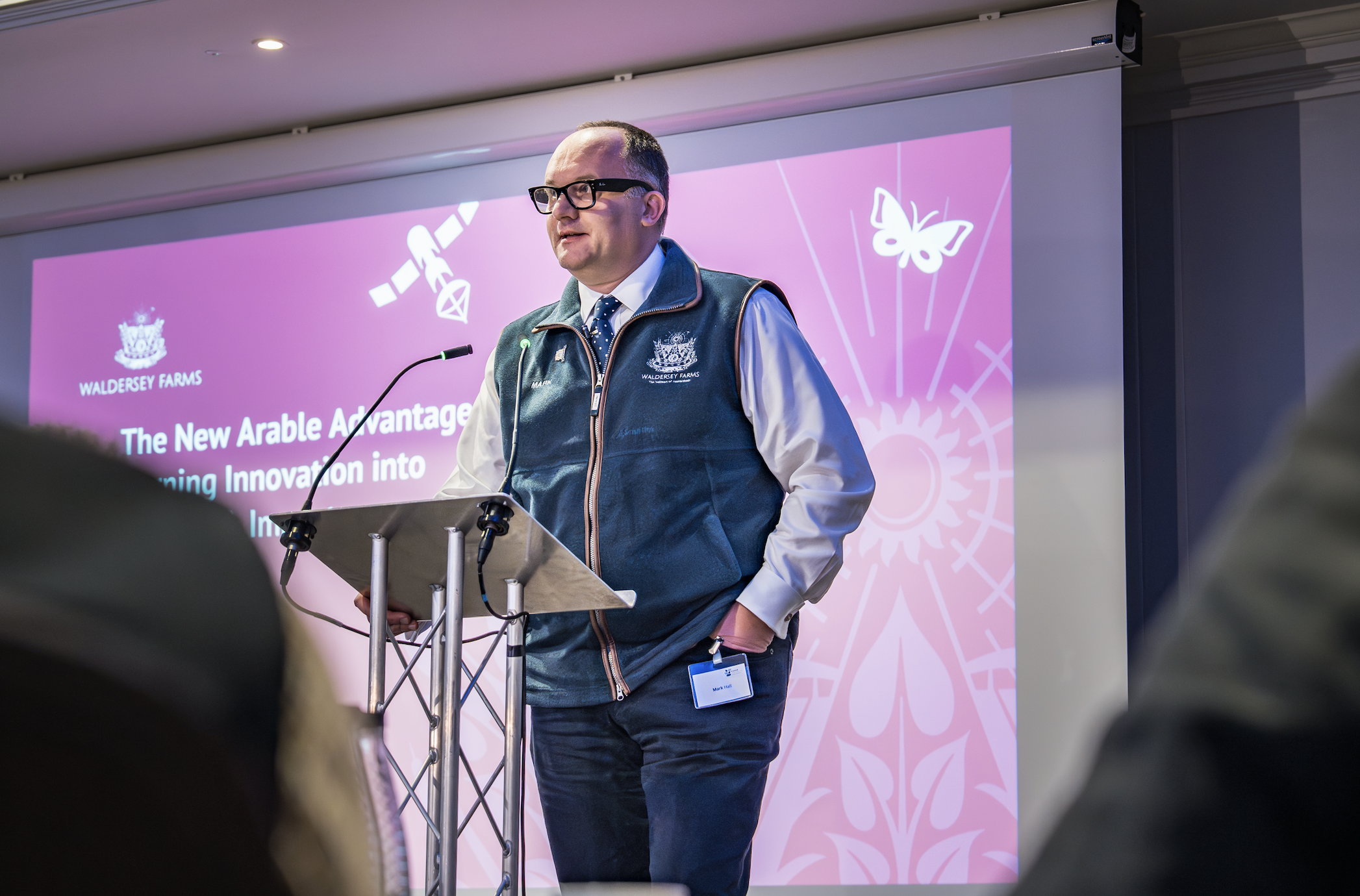

Mark Hall, Managing Director of Waldersey Farms, spoke at the Ceres AgriStrategy Conference on 4th December, examining how technology is shaping the future of farm profitability. The event brought together leading voices in agriculture, including Sir Peter Kendall from Rothamsted Research, Prof Quintin McKellar CBE, Ceres Group Non-Executive Director, and Andrew Meredith from Farmers Weekly.
Mark’s presentation centred on “The New Arable Advantage” which balances income, environmental impact and strategic planning. “No Silicon Valley jargon, no blockchain for barley, just practical technologies that work in the field,” he told attendees.
Waldersey Farms, a large-scale operation in the Fens alongside his own small farming operation, MKH Farming, share one ambition: to farm profitably, sustainably and resiliently. Mark outlined three strategic imperatives: reducing cost of production per tonne, achieving carbon neutrality by 2040, and improving health, safety and welfare for employees.
Addressing market volatility, policy changes, climate pressures and labour challenges, Mark emphasised the opportunities these create. “Innovation isn’t optional, it’s the lever we must pull to stay competitive,” he said.
The farm is already using precision farming, data integration, automation and biologicals to unlock efficiency. “When these systems talk to each other, it’s like turning a collection of tools into a team,” he explained.
He showcased several practical applications, including an AI-led algorithm combining yield maps, soil carbon data and satellite imagery to boost nitrogen use efficiency, reducing synthetic nitrogen, lowering costs and cutting emissions. Ecorobotix spot sprayers are reducing herbicide use by up to 50% for onions, sugar beet and maize, whilst drones map weeds within 72 hours for targeted applications.
Looking ahead, Mark discussed LiDAR mapping for 3D environmental insights, AI-driven predictive agronomy that learns from each season, and Elaniti’s metagenomics soil analysis. “This is the next frontier, because healthy soils underpin everything,” he said.
He concluded that innovation pays through efficiency and risk reduction, whilst delivering impact through soil health and emissions reduction. But success depends on strategy, not just technology purchases.
“It’s not about buying new kit or racing to do something more ‘advanced’ than the neighbour,” he said. “It’s about having clear strategic aims that suit your business and you. Let’s lead innovation, not wait for it”